
Who Made Your Solar Panel? India's ALMM Rules and the China Question
India hopes to build a solar industry that does not turn on another country’s decisions. In modules, it has worked. Further up the chain, the reality is still being decided in China.
By Rohit Rao N, Principal Partner 2 November 2026 9 min read
Key points
- ALMM decides which solar modules and cells a covered project may use. Since 1 June 2026 it also requires listed cells; rooftop and open-access projects have until 31 December 2026.
- The Government’s hope is energy security, fewer imports and an industry India owns. In practice, that means less dependence on China.
- In modules, it has worked. Chinese module shipments to India have almost stopped.
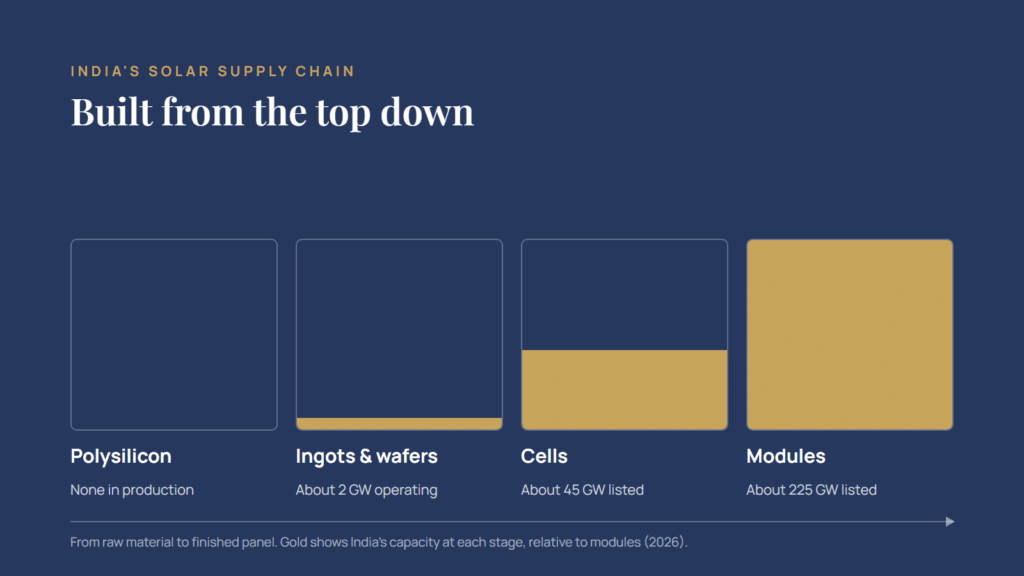
- Upstream, it strains: about 2 GW of wafer capacity, no polysilicon, and factories that still need Chinese equipment and engineers.
- China’s draft export controls of 16 October 2026 reach exactly those upstream steps.
‘Made in India’ is easy to print on a solar panel. Proving it is harder. That, in one line, is why the Government created a list of approved solar modules and cells, model by model and maker by maker: the Approved List of Models and Manufacturers, or ALMM. It is one of several measures India has taken since 2019 to push its solar industry to make more of its own equipment.
On 16 October 2026, China’s commerce and science ministries published a draft list of 40 technologies they propose to prohibit or restrict from export. Twelve are solar technologies. They cover how to make polysilicon, wafers and the newest cells, together with the core equipment behind them.
The two facts are connected. China’s draft covers the very stages India must master to make its own cells and wafers. Caught between them are India’s solar manufacturers, developers, electricity consumers and regulators.
This piece looks at what the Government is trying to achieve, and whether the strategy holds together. Lawyers are known for answering every question with ‘it depends’. Well, this time, it really does.
The list
ALMM lists the specific models of solar modules (List-I) and cells (List-II), each against its manufacturer and the factory that makes it. A maker gets on it only after its product is certified by the Bureau of Indian Standards and its factory is inspected. Being on the list does not guarantee a sale, but not being on it shuts a maker out of every project that ALMM covers.
- Who is covered. The ALMM Order of 2019 began with government projects, government-assisted projects and projects selling power to the government. In January 2022 the Ministry extended it to private projects under net metering and open access. As settled in March 2022, this applies to projects that applied on or after 1 October 2022. Projects that applied earlier are exempt. If your project is one that ALMM covers, you may use only listed products.
- Modules and cells. Covered projects must use modules on List-I. From 1 June 2026, those modules must also be made with cells on List-II.
- The window. Net-metering and open-access projects may be commissioned without listed cells until 31 December 2026. Listed modules are still required. Residential consumers under PM Surya Ghar who give up the subsidy and apply through the National Portal have until 31 March 2027.
- ‘Net metering’ is wider than it sounds. It includes gross metering, net billing, and virtual and group net metering. But a private factory’s or building’s own behind-the-meter plant, used only for its own consumption, is outside both lists.
- Wafers are next. A third list, for wafers, is planned too. As of now, it is set to apply from 1 June 2028. There is no list yet for ingots or polysilicon.
In plain words
- ALMM
- The Approved List of Models and Manufacturers, kept by the Ministry of New and Renewable Energy.
- List-I, List-II, List-III
- The lists for modules, cells and (from 2028) wafers.
- DCR
- Domestic Content Requirement: Indian-made cells and modules, as a condition of a subsidy.
- Net metering and open access
- Net metering lets a rooftop plant send surplus power to the grid against its bill. Open access lets a consumer buy power directly from a generator of its choice.
The hope: what the Government is trying to do
Read on its own, the 2019 Order has a modest aim. The Government wants to be sure that cells and modules “are indeed made in units in which production has been claimed”. A solar plant is expected to run for 25 years. Its warranty is worth something only if a real factory stands behind it. A list of inspected manufacturers gives buyers that comfort. That is a rule about quality and reliability.
But ALMM does not stand alone. The Government has built four tools around the same goal. They are often confused, because all four focus on Indian-made equipment. But each works differently.
- ALMM. It decides which products a covered project may use, whether or not the project takes a subsidy.
- Domestic Content Requirement (DCR). This is a condition of a subsidy. Under schemes such as PM Surya Ghar, the cells and modules must be made in India, or the subsidy is lost.
- Customs duty. Since 2 February 2025, imported cells pay 20% basic customs duty plus a 7.5% Agriculture Infrastructure and Development Cess, about 27.5% in all. Imported modules pay 20% duty plus a 20% cess, or 40% in all.
- Production-linked incentive (PLI). This is a scheme to reward making in India. Rs. 24,000 crore is set aside for makers of high-efficiency modules.
The Government presents the growth of solar manufacturing as part of building a self-reliant India. Read together, these measures serve three aims.
- Energy security. India aims for 500 GW of non-fossil capacity by 2030, and solar is central to that target. Installed solar reached about 171 GW by 30 September 2026. A grid that runs on solar needs a steady supply of panels and their parts. If one country controls that supply, it controls the pace of India’s energy transition.
- Less dependence on imports. An import exposes a project to another country’s prices, trade rules and politics. A module that is cheap today can cost more, or stop coming, tomorrow. Making panels at home is meant to remove that risk, and to keep the money spent on them in India.
- Building capacity. The aim is an industry, not just a supply: factories, skilled jobs and technology that India owns. In time, it is also meant to give India a product to sell abroad.
One thing ties the three together. The dependence these aims attempt to address is, in practice, dependence on China. In July 2026, Reuters reported that about 95% of India’s imported solar cells came from China. Over 99% of its imported wafers in 2025-26 did too. In plain terms, the hope is that India’s solar build-out should not turn on another country’s decisions.
So an order framed around quality has become one of the main levers of an industrial policy. Both purposes, quality and industry, are legitimate. The question is whether the reality matches the hope.
The reality
The reality looks different depending on where you stand. Part of it is a clear success. Much of the rest turns on decisions taken in China.
What has worked
The numbers are striking.
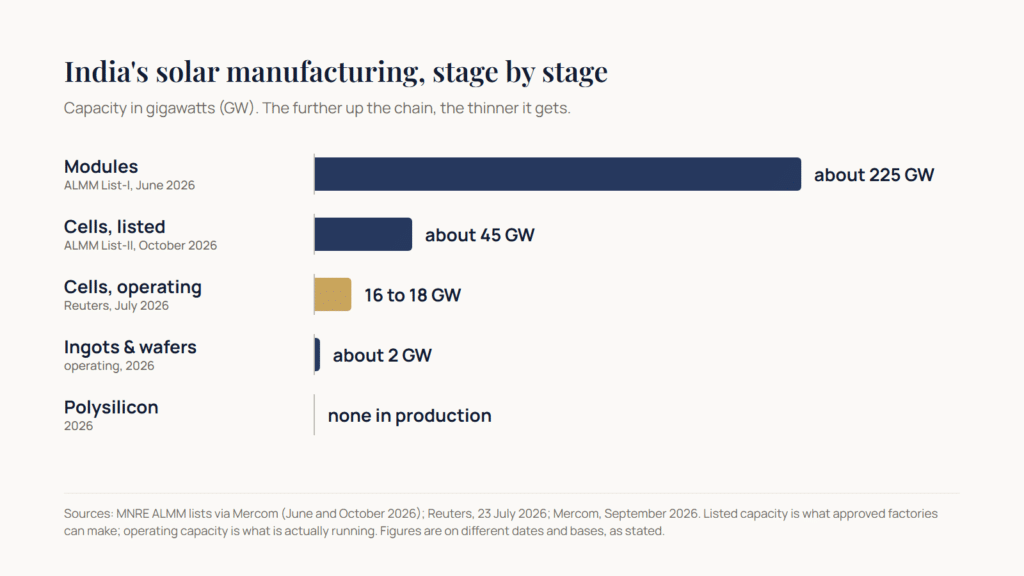
- Modules. ALMM module capacity rose from about 2.3 GW in 2014 to about 225 GW by June 2026.
- Cells. Listed cell capacity grew from about 13 GW on the first List-II in July 2025 to about 45 GW by October 2026.
- Imports. Module imports have fallen sharply. Chinese module shipments to India dropped from 2.68 GW in August 2025, a month of rush buying before the List-II deadline, to 0.07 GW in August 2026. Chinese cell shipments fell too, to about 0.04 GW in August 2026.
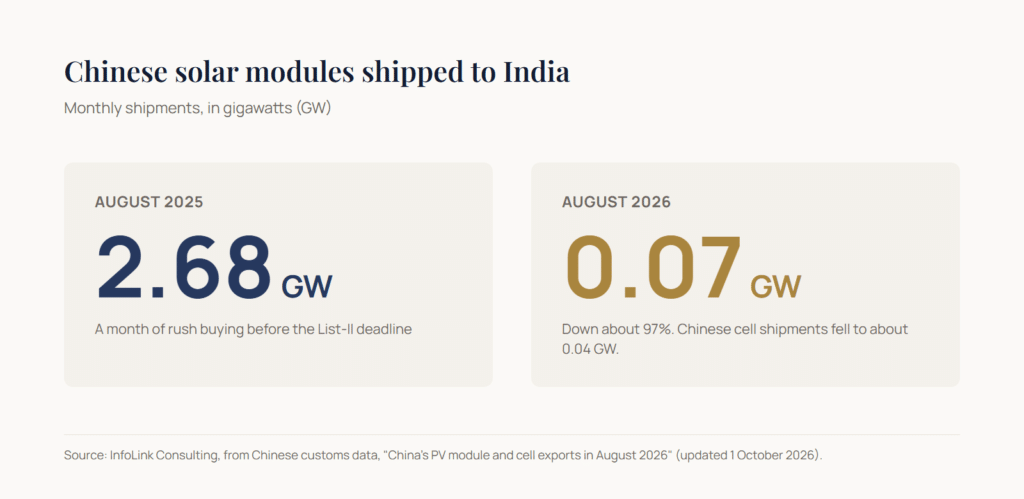
In modules, the policy has done what it set out to do.
Dependence has moved up the chain. It has not gone away.
For manufacturers
Indian makers are on the front line. They depend on China for equipment, wafers and know-how, so they feel China’s decisions first.
- Built from the top down. India built the last step of the chain first. Module capacity is about seven times cell capacity, and more than a hundred times ingot and wafer capacity. About 2 GW of ingot and wafer capacity is operating, and there is no polysilicon production yet. Even the factories that exist rely on China for equipment, spare parts, process software, industrial gases and skilled engineers. Dependence has moved up the chain. It has not gone away.
- The list is not the factory floor. In July 2026, Reuters reported about 27 GW of cell capacity on the Government’s estimate, but only 16 to 18 GW actually operating. List-II has since grown to about 45 GW. A listing shows what a factory can make, not what it actually makes.
- Supply rerouted, not replaced. More cells now arrive from Indonesia and elsewhere, often made with Chinese inputs. India’s proposed anti-dumping duty on Chinese cells was recommended in September 2025. A year later it had still not been notified.
- China’s controls land here first. Since 16 October 2026, Chinese exporters must register before exporting a listed solar technology. Reuters reported in July 2026 that exports of equipment, technology and technical support to India had already been curbed, delaying new cell plants. Silver, a key input for cells, has needed a Chinese export licence since 1 January 2026.
- Too many module lines, one export market. India’s module factories run at only 35 to 40% of capacity, according to IEEFA and JMK Research. About 97% of module exports in FY 2025-26 went to the United States, which sets minimum import prices for solar products from 4 December 2026. Reuters reported that since 1 June 2026 nearly a third of small and medium module makers had stopped production.
For developers and consumers
Developers and consumers no longer buy much from China directly. But China’s prices and India’s rules together decide what a plant costs, and when it can start.
- The cheaper option, held back. China makes far more than the world can buy. At the end of 2025 it had about 1,100 GW of module capacity, against world installations of about 650 GW. Its own installations fell 66% in the first half of 2026, and its largest makers are losing money. So Chinese modules leave China about a fifth cheaper than modules assembled in India. Only ALMM and customs duty keep that price from reaching Indian projects. China’s own policy is narrowing the gap a little. It ended export rebates on solar products from 1 April 2026, and plans a consumption tax on cells from 1 April 2027.
- Who pays. The rules come at a price. In September 2026, modules with Indian cells cost roughly two-thirds more than modules without them. In May 2026, rooftop installers in Rajasthan quoted Rs. 22 a watt or more for such modules, against Rs. 13 to 15 for others. On those quotes, a 5 kW home system rises from about Rs. 2.40 lakh to about Rs. 3.05 lakh before subsidy, or about Rs. 65,000 more. When the List-II requirement was announced in December 2024, the ratings agency CareEdge estimated that it would push tariffs up by 40 to 50 paise a unit in the short run. No published figure has yet tested that estimate, but the price gap points the same way. Rooftop homes and small businesses feel this first. Rooftop timelines have also slipped, because modules with Indian cells are in short supply.
- Rules ahead of supply. Between 25 May and 18 July 2026, the Ministry issued six orders on the List-II deadline. The first refused a blanket extension. The last replaced the other five and opened the window to 31 December 2026. Each order may have been sensible on its own. But together, they made planning and financing harder. For an investor, uncertainty is also a cost.
For regulators
Regulators feel China’s decisions only at one remove, through the Ministry’s orders. But they are the ones who carry those orders into practice.
- Checking compliance. The distribution companies that connect rooftop plants to the grid are expected to check ALMM compliance before commissioning them.
- Keeping up with change. Each new order from the Ministry has to be built into their portals and procedures. When the orders change often, so must their procedures.
None of this means the strategy is wrong. It means the strategy has a sequencing problem. The list moved faster than the supply chain beneath it.
Rules can fill a list. Only factories, machines and engineers can fill a supply chain.
What could happen next
China’s draft of 16 October is the main uncertainty. If it is finalised, Chinese firms would need permission to export key know-how for polysilicon, ingots and wafers, and for the leading cell technologies (TOPCon, heterojunction and back-contact), along with the core equipment. China says the draft targets no country. But it reaches exactly the steps India must take to meet its wafer list by June 2028. That list has a hurdle of its own. Under the Ministry’s order of 17 March 2026, it will not be issued until at least three independent wafer makers have at least 15 GW a year of capacity between them. India has about 2 GW of ingot and wafer capacity operating today.
Analysts see three ways this could play out. These are projections, not facts.
- Delay. Equipment and know-how arrive more slowly, or from costlier European suppliers. Indian cell and wafer plants take longer. EUPD Research expects the cell gap to take three to five years to close. JM Financial suggests India may then relax the List-II requirement beyond December 2026.
- Price pressure. Chinese makers, with too much stock and the US closing its doors, price finished cells and modules more aggressively wherever Indian rules still allow imports.
- Higher costs at home. Wood Mackenzie projects Indian utility-scale system prices about 20% higher by the end of 2026, with little relief before 2029.
There is another side. JM Financial calls the draft “structurally positive” for Indian manufacturing, though disruptive in the short term. Know-how that cannot be bought must be built. That is slower and costlier, but it is harder to take away.
What to watch
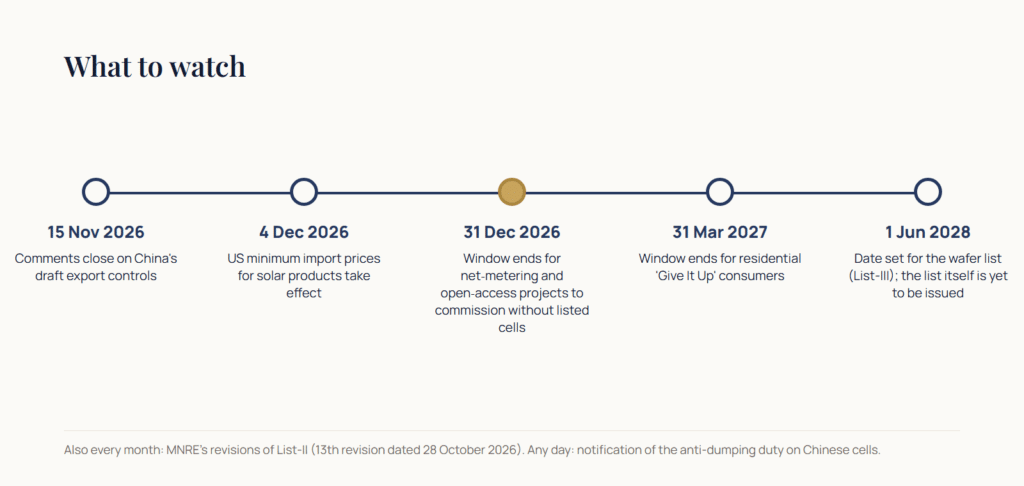
- 15 November 2026: comments close on China’s draft export controls.
- 4 December 2026: US minimum import prices for solar products take effect, closing another outlet for Chinese supply.
- 31 December 2026: the window ends for net-metering and open-access projects to commission without listed cells.
- 31 March 2027: the window ends for residential ‘Give It Up’ consumers.
- Every month: the Ministry’s revisions of List-II. The 13th revision is dated 28 October 2026. Watch the gap between listed and operating capacity.
- Any day: notification of the anti-dumping duty on Chinese cells.
- 1 June 2028: the date set for the wafer list (List-III) to take effect. The rule is in place, but the list itself has not yet been issued.
So where does this leave us?
First, the hope is sound on its own terms. A country that wants solar to carry its grid cannot leave its supply to one country. China’s October draft shows why.
Second, the reality will be decided upstream. Rules can fill a list. Only factories, machines and engineers can fill a supply chain. Until Indian cells and wafers catch up with the rules, Indian manufacturers, developers and consumers will carry the cost of the transition. The question for the next two years is not whether India should build its own solar industry. It is how fast it can, and who pays in the meantime.
Sources
- Ministry of New and Renewable Energy: ALMM Order, 2 January 2019; amendments of 13 January 2022 and 28 March 2022; 9 December 2024 (List-II); 25 May 2026; 18 July 2026; 4 August 2026; 17 March 2026 (wafers).
- Press Information Bureau, “Manufacturing Momentum: Building a Self-Reliant India”, August 2026.
- Energetica India, “China proposes export controls on 12 solar PV technologies”, 17 October 2026.
- Reuters, via Khaleej Times, “India’s solar push idles factories unable to shake reliance on China”, 23 July 2026.
- InfoLink Consulting, “China’s PV module and cell exports in August 2026”, updated 1 October 2026.
- Mercom India: List-II capacity, 30 October 2026; polysilicon and wafers, 11 September 2026; 1H 2026 manufacturing (via pv magazine), 25 September 2026; rooftop timelines, 30 July 2026.
- IEEFA and JMK Research, via pv magazine, 1 September 2026.
- Angel One, Commerce Ministry trade data, 7 July 2026.
- Prices: GreentechLead, 7 September 2026; Patrika, 13 May 2026; OPIS and InfoLink price reports, October 2026; CareEdge Ratings, 20 December 2024.
- Customs duty: Budget 2025-26 summary. PLI: Energetica India, 22 March 2026. Anti-dumping duty: Reslink, 8 September 2026.
- China: CPIA capacity (pv magazine, 10 February 2026); Intertek CEA (pv magazine, 3 September 2026); China installations and US import floors (pv magazine USA, 7 August 2026); silver export licences (Trivium China, 7 January 2026).
- Projections: Wood Mackenzie, 13 August 2026; JM Financial, October 2026.
- Installed capacity: SolarQuarter, 21 October 2026, from MNRE data.