
Insight · Solar policy
Will the Sun Shine on India's Solar Panels? The ALMM Rules and the China Question
Climb onto a new rooftop and the panel will say it was made in India. The Government's list of approved solar products is meant to make that true. For the finished panel, it largely is. For its components, though, the answer is still being decided in China.
Key points
- The ALMM is the Government's list of approved solar modules and cells. Covered projects may use only listed products, and since 1 June 2026 their modules must also be made with listed cells. Rooftop and open-access projects have until 31 December 2026.
- The aim is energy security, fewer imports and an industry India owns. In practice, that means less dependence on China.
- For modules, it has worked. Chinese module shipments to India have almost stopped.
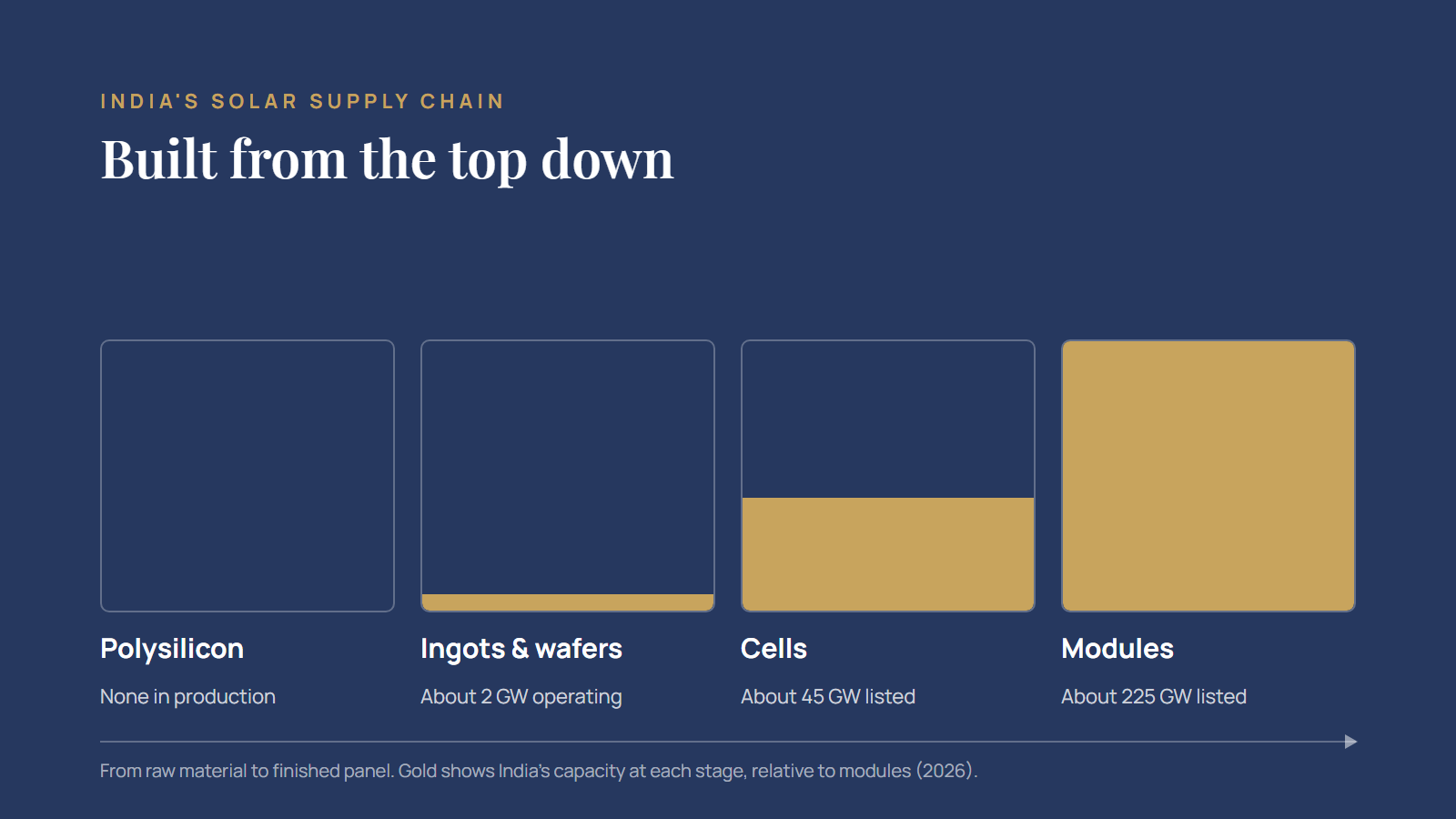
- Further up the chain, it strains: about 2 GW of wafer capacity, no polysilicon, and factories that still need Chinese machines and engineers.
- China's draft export controls of 16 October 2026 reach exactly those upstream steps.
Climb onto almost any new rooftop in India and look at the back of a solar panel. There will be a label saying it was made in India, and the label will be telling the truth, at least largely. The panel was assembled here. The reason for this can be traced back to 2019, when the Indian Government started focusing on promoting Indian-made solar panels and components.
However, ask where the cells inside the panel come from, or the thin wafer of silicon inside those cells, and the honest answer for most of the panels would be China.
And now, in a draft published on 16 October 2026, China proposes to prohibit or restrict the export of twelve solar technologies and know-how. They range from how to make polysilicon, wafers and the newest cells to the core equipment behind them, the very steps India has yet to master.
So the question is a simple one. Can the current policies make India independent of China in making its solar equipment, and who pays while India tries? The answer, I am afraid, is the lawyer's favourite: "it depends". This article tries to shed some light on what it depends on.
What the Government has done
The Government's main instrument is a list. The Ministry of New and Renewable Energy, which drives solar policy, keeps an Approved List of Models and Manufacturers, known as the ALMM. This list initially covered module manufacturers. A manufacturer of modules can get on the list only after the Bureau of Indian Standards has certified its product and its factory has been inspected. The Government has now created a similar list for cell manufacturers as well.
Being on List-I (modules) or List-II (cells) ought to ensure that listed modules and cells are really made in the factories named. Being listed does not guarantee a sale. But not being listed shuts a maker out of every project the ALMM covers.
Inside a solar panel
Five steps from silicon to rooftop, and which ALMM list covers each.
- PolysiliconVery pure silicon, made from quartzNo list
- IngotThe silicon melted and grown into a solid blockNo list
- WaferThe block sliced paper-thinList-III, 2028
- CellA wafer treated so that it turns sunlight into electricityList-II
- ModuleMany cells wired together behind glass in a frame: what most people call a solar panelList-I
Who must buy from the list
By an Order of January 2019, the MNRE mandated that all solar projects owned by the Government, or assisted by it, or selling power to it, shall use panels from makers on the ALMM. In January 2022 the Ministry extended this mandate to private projects under net metering and open access. From 1 June 2026, all projects covered under the mandate must have modules that are made with cells on List-II.
There is a window. Net-metering and open-access projects may still be commissioned without listed cells until 31 December 2026, though listed modules remain compulsory. Householders under PM Surya Ghar who take the subsidy must already use Indian-made cells and modules. Those who give up the subsidy and apply through the National Portal have until 31 March 2027 before their modules must be made with listed cells. The list does not apply to a private factory's or building's own behind-the-meter plant, used only for its own consumption. The Government has also announced a third list, for wafers, set to apply from 1 June 2028. For ingots and polysilicon there is no list at all.
In plain words
- Net metering
- Lets a rooftop plant send surplus power to the grid against its bill.
- Open access
- Lets a consumer buy power directly from a generator of its choice.
- Behind-the-meter plant
- A plant on the consumer's own side of the electricity meter, whose power is used on site and not sent to the grid.
Why the Government made the list
Read on its own, the 2019 Order has a modest aim. The Government wanted to be sure that cells and modules "are indeed made in units in which production has been claimed". A solar plant is expected to run for 25 years, and its warranty is worth something only if a real factory stands behind it. A list of inspected makers gives the buyer that comfort. That is a rule about quality.
But the list does not stand alone. Together with the Domestic Content Requirement (DCR), under which subsidised projects must use Indian-made cells and modules, and higher customs duty on imported cells and modules, it is part of the Government's larger aim of a self-reliant India. These measures serve three aims. The first is energy security. India aims for 500 GW of non-fossil capacity by 2030, solar is central to that target, and installed solar had reached about 171 GW by 30 September 2026. A grid that runs on the sun needs a steady supply of panels and their parts, and whoever controls that supply controls the pace of the transition. The second is fewer imports. An imported module that is cheap today can cost more, or stop coming, tomorrow, and the money spent on it leaves the country. The third is an industry India owns: factories, skilled jobs and technology, and in time something to sell abroad.
All three rest on one hope: that India's solar build-out should not turn on decisions taken in another country. In practice, that country is China. In July 2026, Reuters reported that about 95% of India's imported solar cells came from China, and over 99% of its imported wafers in 2025-26 did too. So an order framed around quality has become one of the main levers of an industrial policy. I see nothing wrong in that, for both purposes are legitimate. The question is whether the reality has kept pace with the hope. For the finished panel, it has.
What appears to have worked
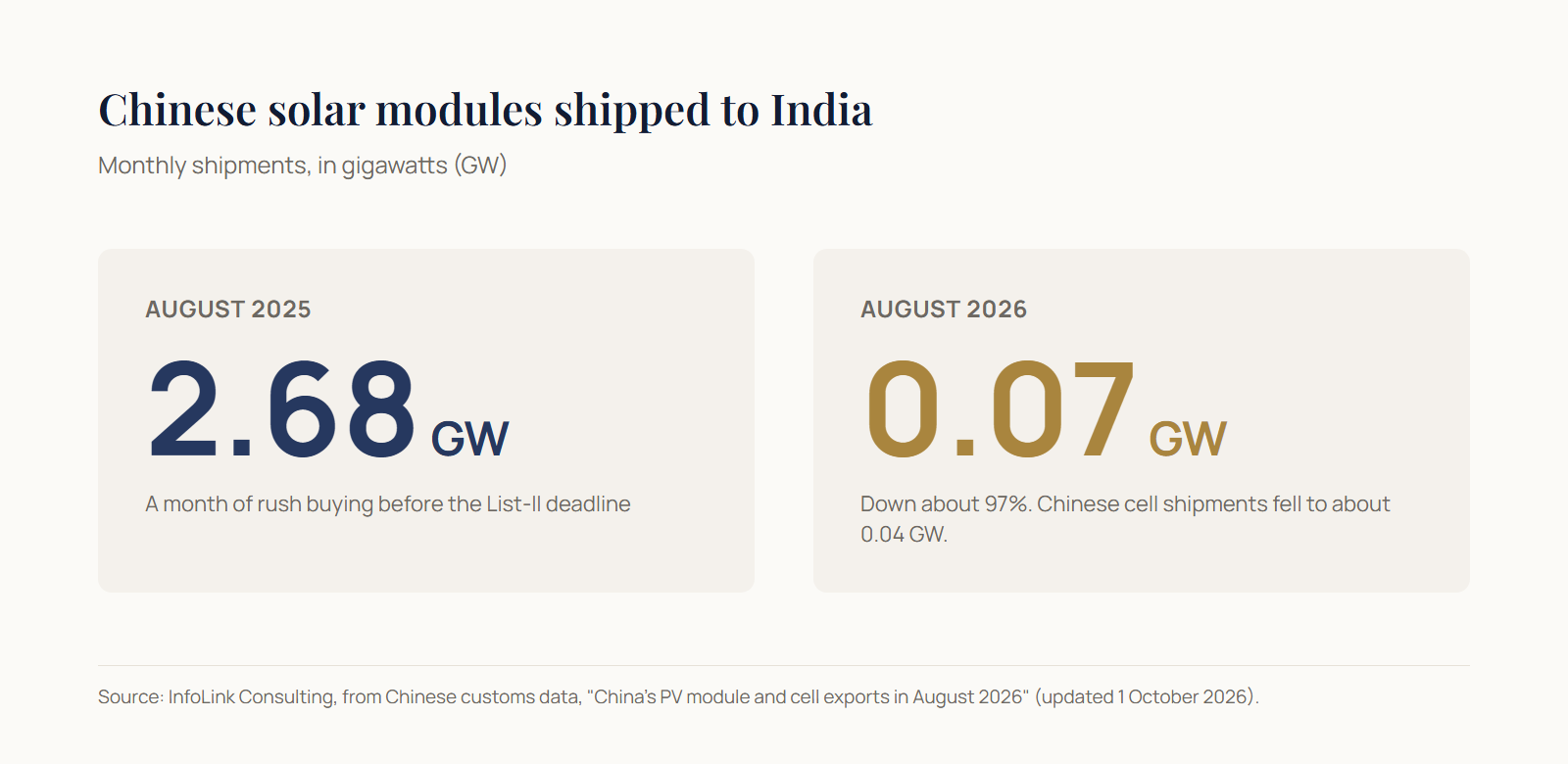
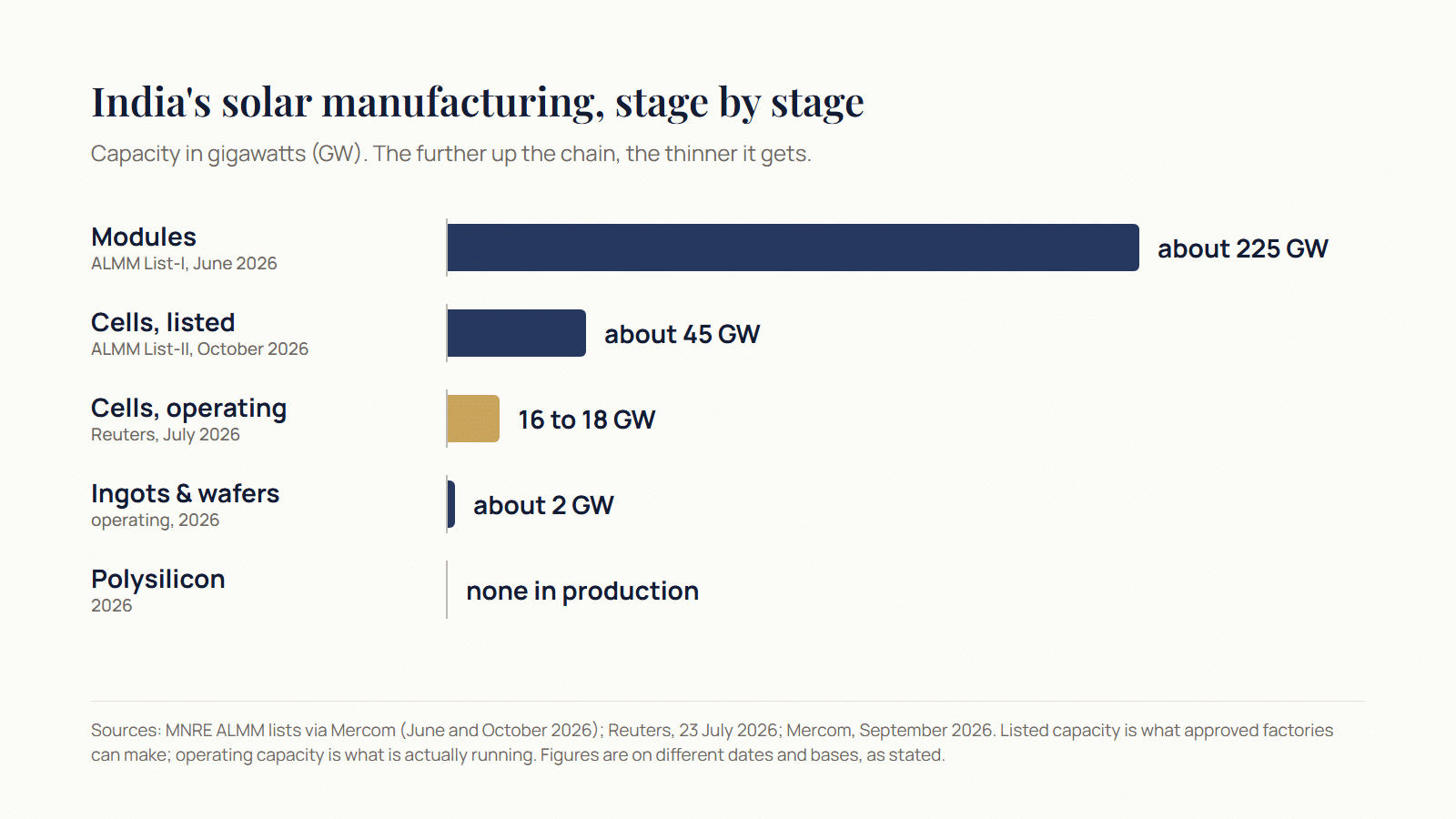
Listed module capacity rose from about 2.3 GW in 2014 to about 225 GW by June 2026. Now look at the border. In August 2025, a month of rush buying before the List-II deadline, China shipped 2.68 GW of modules to India; in August 2026 it shipped 0.07 GW. Its cell shipments fell too, to about 0.04 GW. In modules, the policy has done what it set out to do.
What the "Made in India" label does not reveal
Assembling a module is the easy part. Indian factories buy cells, wire them together behind glass and frame them, and they now do so on a large scale. But, making the cell is another matter. A cell begins as polysilicon, which India does not yet make at all, and then becomes a wafer, of which India makes very little. For both, as of now, India turns to China.
So the Indian manufacturers of solar components feel China's decisions first. They depend on China for their machines, for their wafers and for much of the know-how to run the line.
The capacity figures show how wide the gap is. Module capacity is now about seven times cell capacity, and more than a hundred times ingot and wafer capacity, of which only about 2 GW is running. Even the factories that do exist rely on China for equipment, spare parts, process software, industrial gases and skilled engineers.
So Indian manufacturers can add cell lines only as fast as China will sell them the wafers and the machines to run them. That cell making will catch up with module making any time soon is, for now, unlikely.
Dependence has moved up the chain. It has not gone away.
List-II: a roof without walls
The Government's insistence that every module use cells from List-II is like asking for a house to be built roof first. The roof may be well made and duly inspected, but it has no walls to rest on, and the bricks for the walls must still be bought from a neighbour who has begun to wonder whether to sell them or not.
In its current form, the Government's approach seems unworkable, and the Ministry's own orders suggest as much. Between 25 May and 18 July 2026 it issued six orders on the List-II deadline, and the last of them gave rooftop and open-access projects until 31 December 2026. In my view, a rule that must be held back six times in eight weeks asks more than the supply chain can yet give. Until wafers are made in India, List-II will raise costs and slow projects faster than it builds the walls.
What China may decide
China's draft of 16 October is now the main uncertainty. If it is finalised, Chinese firms would need permission to export the know-how for polysilicon, ingots, wafers and the leading cell technologies (TOPCon, heterojunction and back-contact), and the core equipment. China says the draft targets no country. But it reaches exactly the steps India must master to make its own cells and wafers.
Analysts foresee three ways this could play out. The first is delay: equipment and know-how arrive more slowly, or from costlier European suppliers, and Indian cell and wafer plants take longer. EUPD Research expects the cell gap to take three to five years to close, and JM Financial suggests that India may then relax the List-II requirement beyond December 2026. The second is price pressure: China, with excess stock, can continue to price finished cells and modules more aggressively wherever Indian rules still allow imports. The third is higher costs at home. Wood Mackenzie has projected that Indian utility-scale system prices would be about 20% higher by the end of 2026, with little relief before 2029.
Who pays
These rules have a price, and the person who pays it is the householder who wants panels on the roof. In September 2026, modules made with Indian cells cost roughly two-thirds more than modules made without them. Rooftop installers in Rajasthan were quoting, in May 2026, Rs. 22 a watt or more for such modules, against Rs. 13 to 15 for the others. Put those quotes on a 5 kW home system and its cost before subsidy climbs from about Rs. 2.40 lakh to about Rs. 3.05 lakh. The family pays some Rs. 65,000 more, and its roof catches not a single extra ray of sun.
The cost reaches the tariff as well. When the List-II requirement was announced in December 2024, the ratings agency CareEdge estimated that it would push tariffs up by 40 to 50 paise a unit in the short run. No published figure has yet tested that estimate, but the price gap points the same way. Rooftop homes and small businesses feel it first, and they have also waited longer, because modules with Indian cells are in short supply.
Uncertainty has added a cost of its own. Each of the Ministry's orders on the deadline may by itself seem reasonable, but together they have made planning and financing harder. To an investor, uncertainty is a cost like any other. The distribution companies, which are expected to check ALMM compliance before they connect a rooftop plant, have had to build every change into their portals and procedures.
None of this means the strategy is wrong. It means the list moved faster than the supply chain beneath it.
Rules can fill a list. Only factories, machines and engineers can fill a supply chain.
What should a buyer ask now?
For a factory owner or a householder weighing a solar plant today, the practical questions are few. Firstly, does the ALMM apply at all? A plant behind the meter, used only for one's own consumption, is outside it; a net-metering or open-access plant is inside it. Secondly, when will the plant be commissioned? A net-metering or open-access project commissioned by 31 December 2026 needs listed modules but not yet listed cells, while one commissioned after that date needs both. Thirdly, will the plant claim a subsidy? If it will, the domestic content rule applies as well, and the cells and modules must be made in India. In every case the installer should be able to name, in writing, the List-I model and, where it is needed, the List-II cell. If the installer cannot, that is the moment to ask why.
Dates to watch
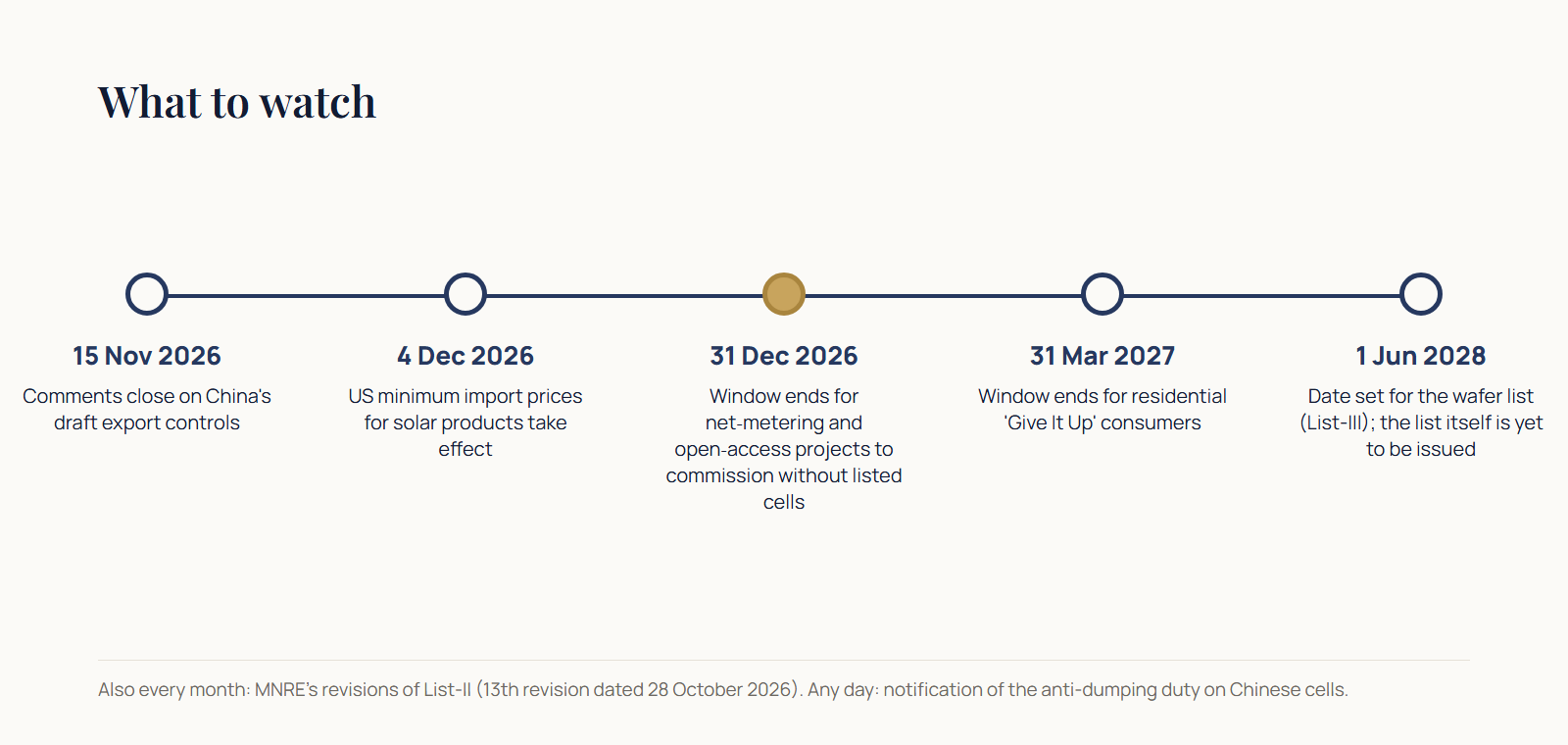
- 15 November 2026: comments close on China's draft export controls.
- 4 December 2026: US minimum import prices for solar products take effect, closing another outlet for Chinese supply.
- 31 December 2026: the window ends for net-metering and open-access projects to commission without listed cells.
- 31 March 2027: the window ends for residential 'Give It Up' consumers.
- Every month: the Ministry's revisions of List-II. The 13th revision is dated 28 October 2026. Watch the gap between listed and operating capacity.
- Any day: notification of the anti-dumping duty on Chinese cells.
- 1 June 2028: the date set for the wafer list (List-III) to take effect. The rule is in place, but the list itself has not yet been issued.
Will the sun shine?
The hope is sound on its own terms. A country that wants the sun to carry its grid cannot leave the supply of its panels to one other country, and China's October draft shows why. JM Financial even calls that draft "structurally positive" for Indian manufacturing, though disruptive in the short term, and I think there is force in that. Know-how that cannot be bought must be built. Building it is slower and costlier, but what a country builds for itself is harder to take away. But the reality will be decided upstream. Until Indian cells and wafers catch up with the rules, India's manufacturers, developers and householders will carry the cost of the wait, and the question for the next two years is how fast India can build, and who pays in the meantime.
So the label on the back of the panel is not wrong. It is early. Whether it becomes the whole truth will be decided not in a ministry in Delhi, but in factories that do not yet exist, built with machines that China may soon decline to sell.
Sources
- Ministry of New and Renewable Energy: ALMM Order, 2 January 2019; amendment of 13 January 2022; 9 December 2024 (List-II); 25 May 2026; 18 July 2026; 4 August 2026; 17 March 2026 (wafers).
- Press Information Bureau, "Manufacturing Momentum: Building a Self-Reliant India", August 2026.
- Energetica India, "China proposes export controls on 12 solar PV technologies", 17 October 2026.
- Reuters, via Khaleej Times, "India's solar push idles factories unable to shake reliance on China", 23 July 2026.
- InfoLink Consulting, "China's PV module and cell exports in August 2026", updated 1 October 2026.
- Mercom India: List-II capacity, 30 October 2026; polysilicon and wafers, 11 September 2026; 1H 2026 manufacturing (via pv magazine), 25 September 2026; rooftop timelines, 30 July 2026.
- Angel One, Commerce Ministry trade data, 7 July 2026.
- Prices: GreentechLead, 7 September 2026; Patrika, 13 May 2026; CareEdge Ratings, 20 December 2024.
- Customs duty: Budget 2025-26 summary. Anti-dumping duty: Reslink, 8 September 2026.
- US import floors: pv magazine USA, 7 August 2026.
- Projections: Wood Mackenzie, 13 August 2026; JM Financial, October 2026.
- Installed capacity: SolarQuarter, 21 October 2026, from MNRE data.